Launch offer — valid today only

📄 Digital book in PDF · read it on your phone or print it

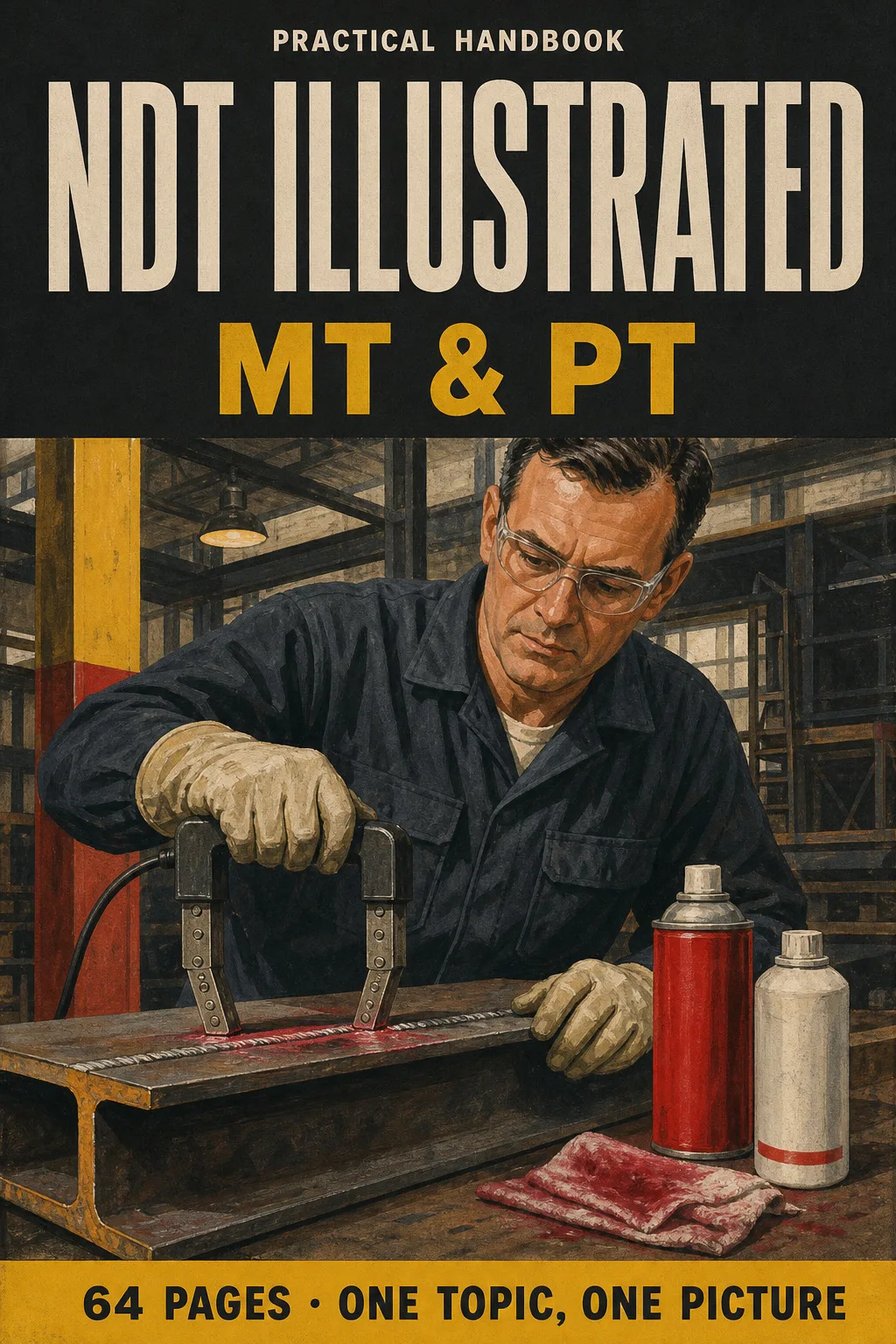
MT & PT for Level I and II, All Drawn One Topic on Every Page

Pick MT or PT at a glance, place the yoke shots, run the six PT steps in order and sort every indication with the same three questions. Every topic has its own page: first the drawing, then the numbers to remember. 64 illustrated pages.

I WANT TO STUDY MT & PT THIS WAY

🔒 Secure checkout · PDF by email · 30-day guarantee

Every topic, its own pageEach technique drawn, with the explanation right beside it
64 illustrated pages8 parts, from where MT and PT fit to the last-night checklist
Up-to-date sourcesASNT SNT-TC-1A, ASME Section V and ASTM E1444/E1417
PDF by emailFormat

Look Inside the Book

Every page has one big drawing and a box with the steps and numbers you need to know:

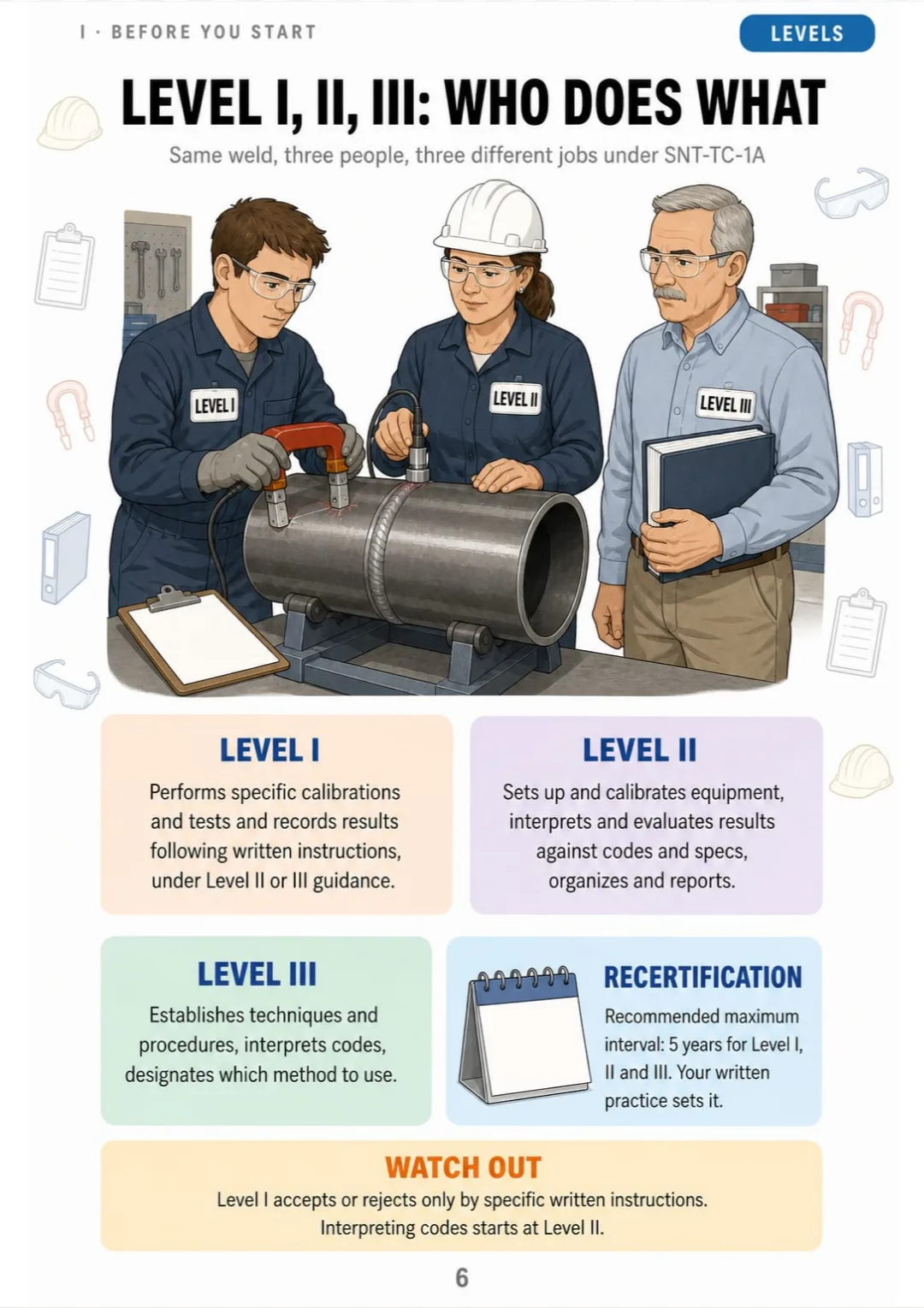
Level I tests by instruction · Level II calibrates and interprets · Level III sets procedures.
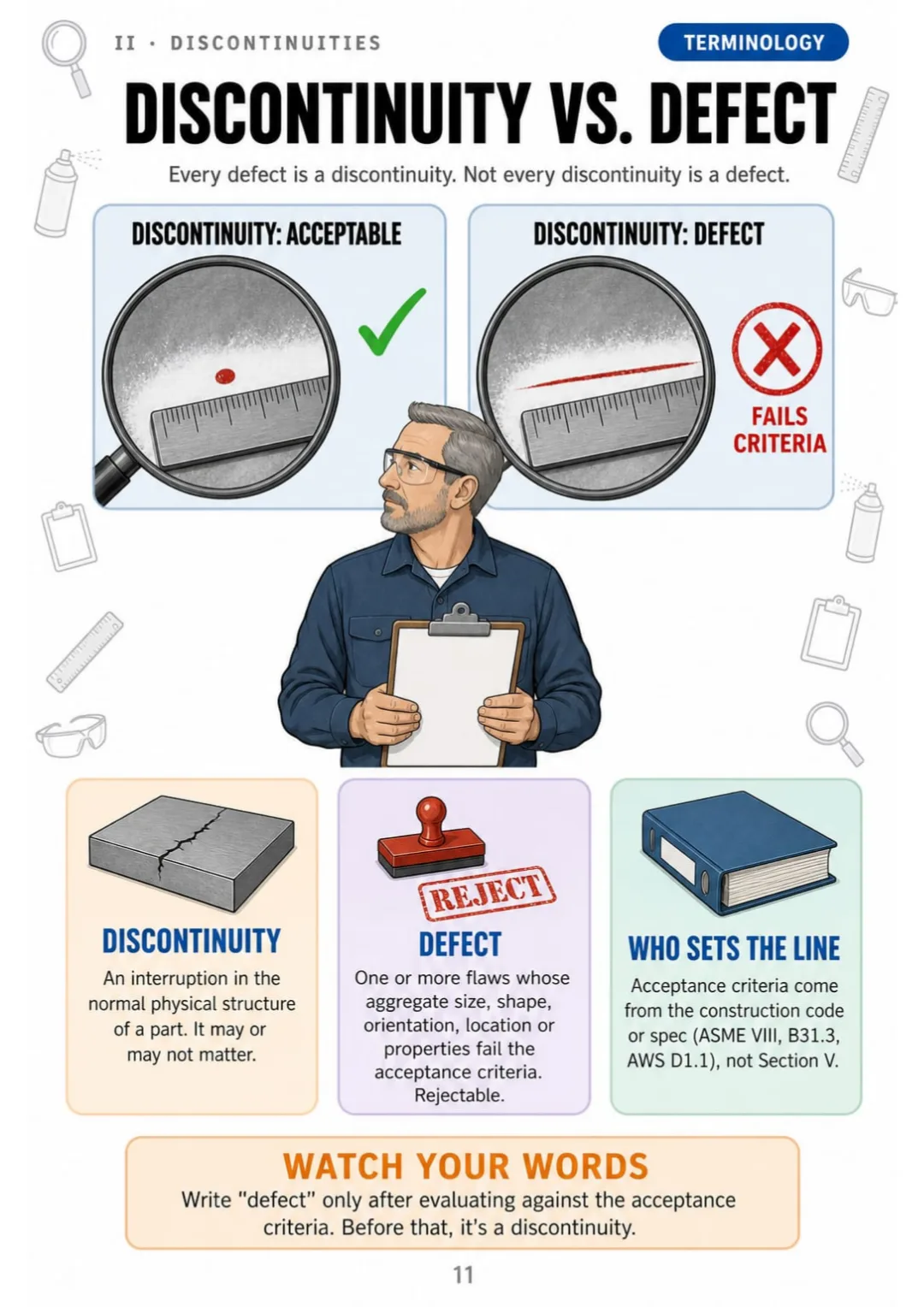
Defect = a discontinuity that fails the acceptance criteria (ASTM E1316 terminology).
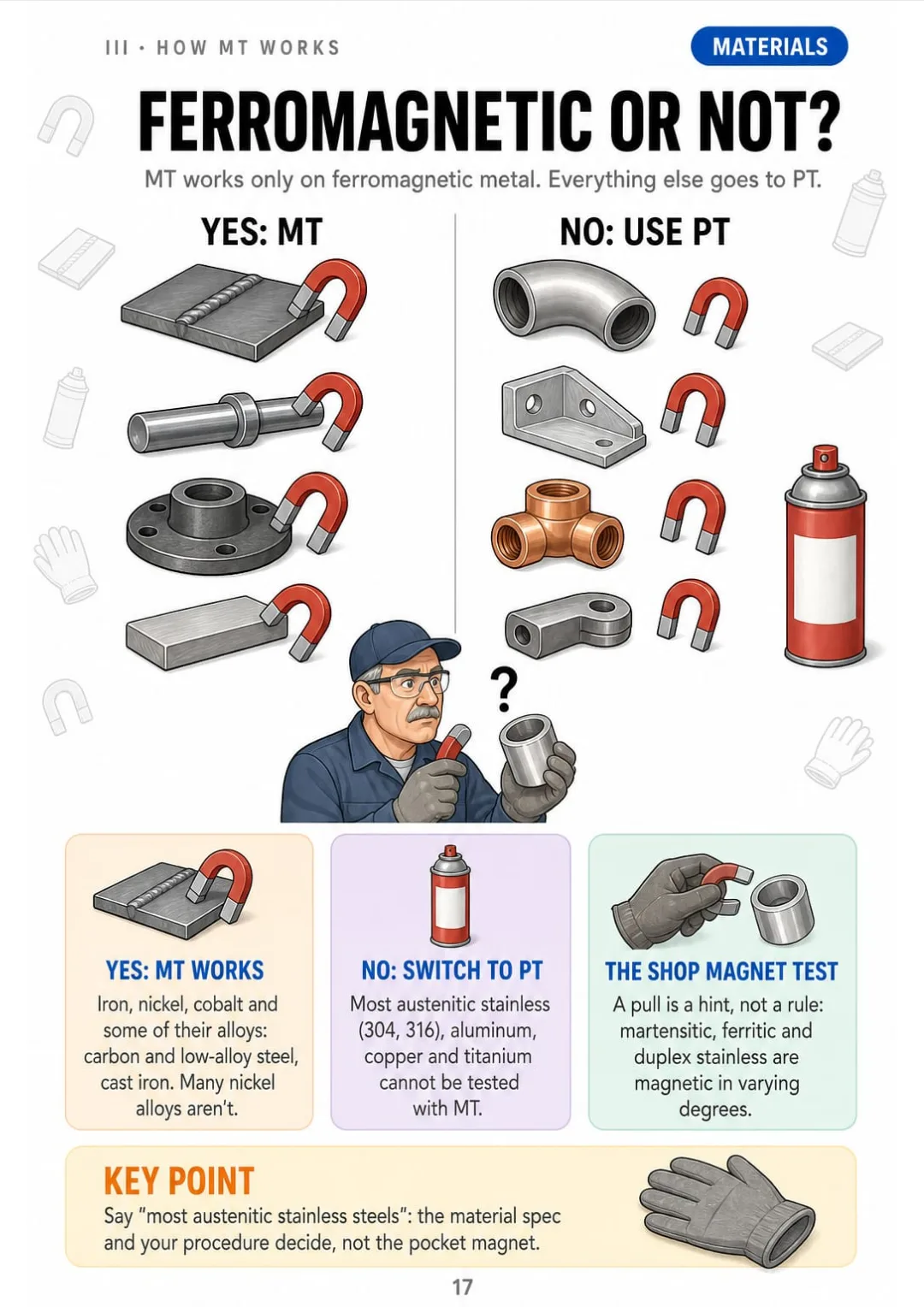
MT only on ferromagnetic metal: most 304/316 stainless, aluminum, copper and titanium go to PT.
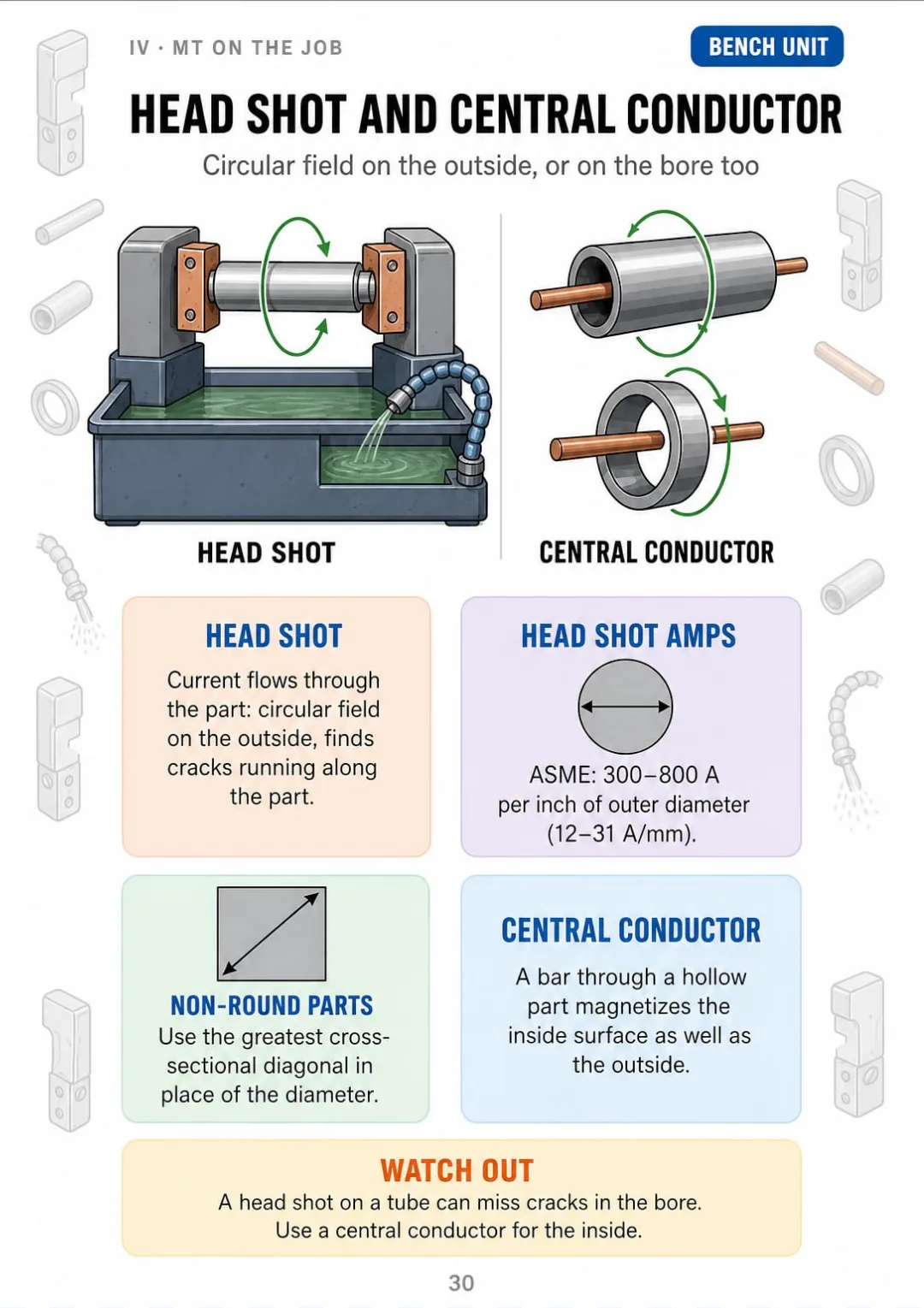
Head shot: 300–800 A per inch of OD (ASME). Central conductor also reaches the inside surface.
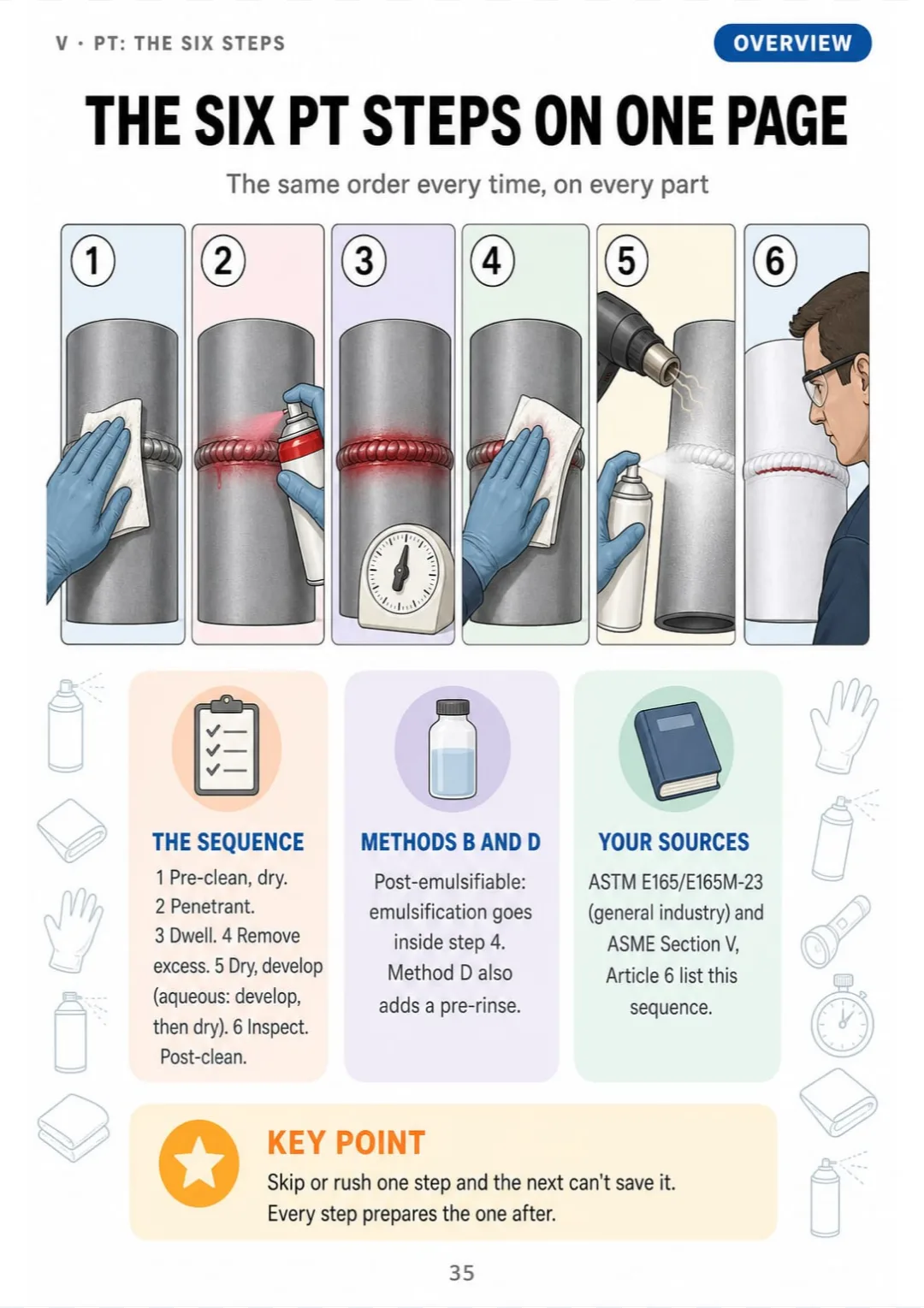
PT in six panels: clean, penetrant, dwell, remove excess, dry and develop by developer type, inspect, then post-clean.
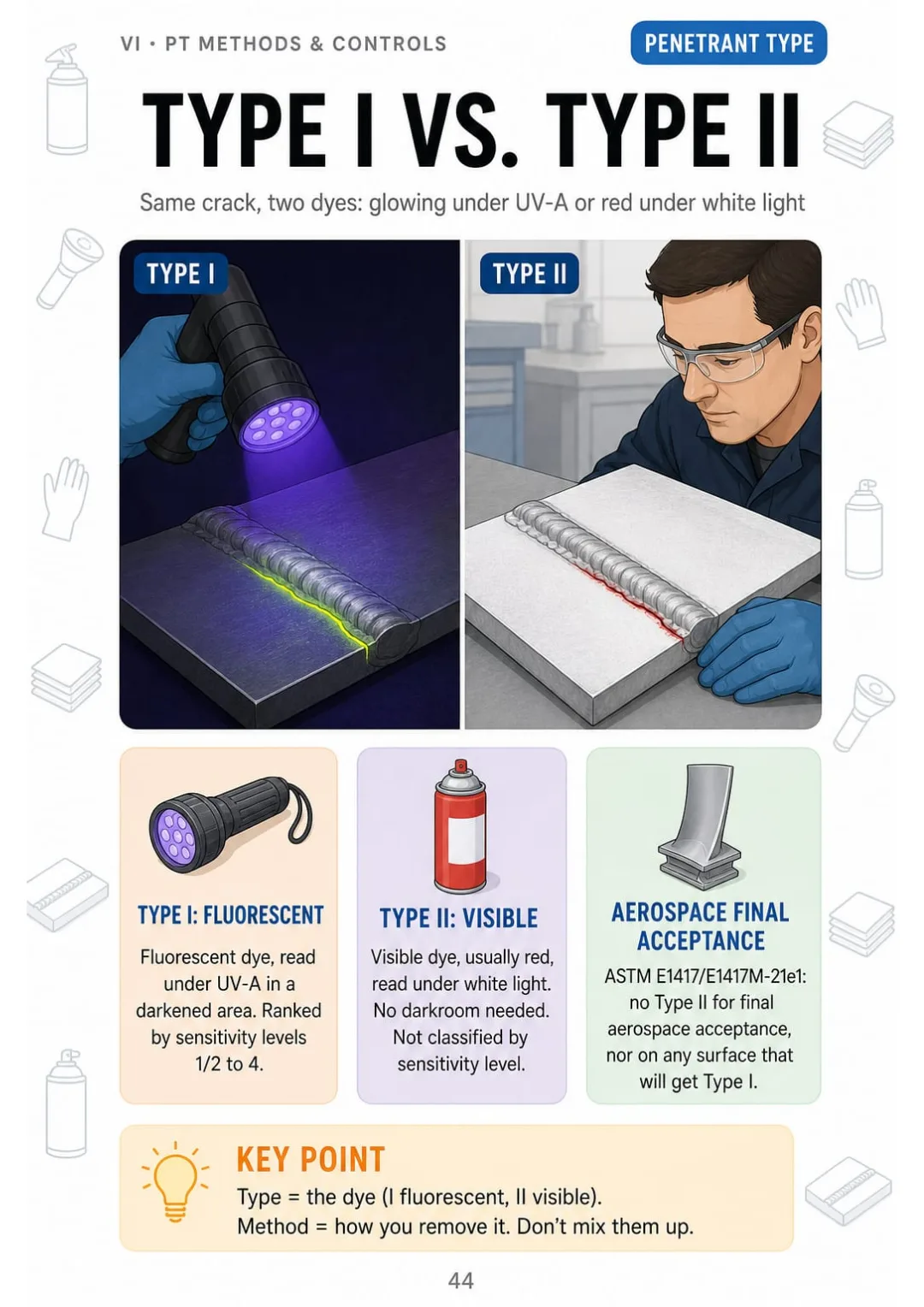
Type I fluorescent under UV-A · Type II visible red under white light · per ASTM E165 and E1417
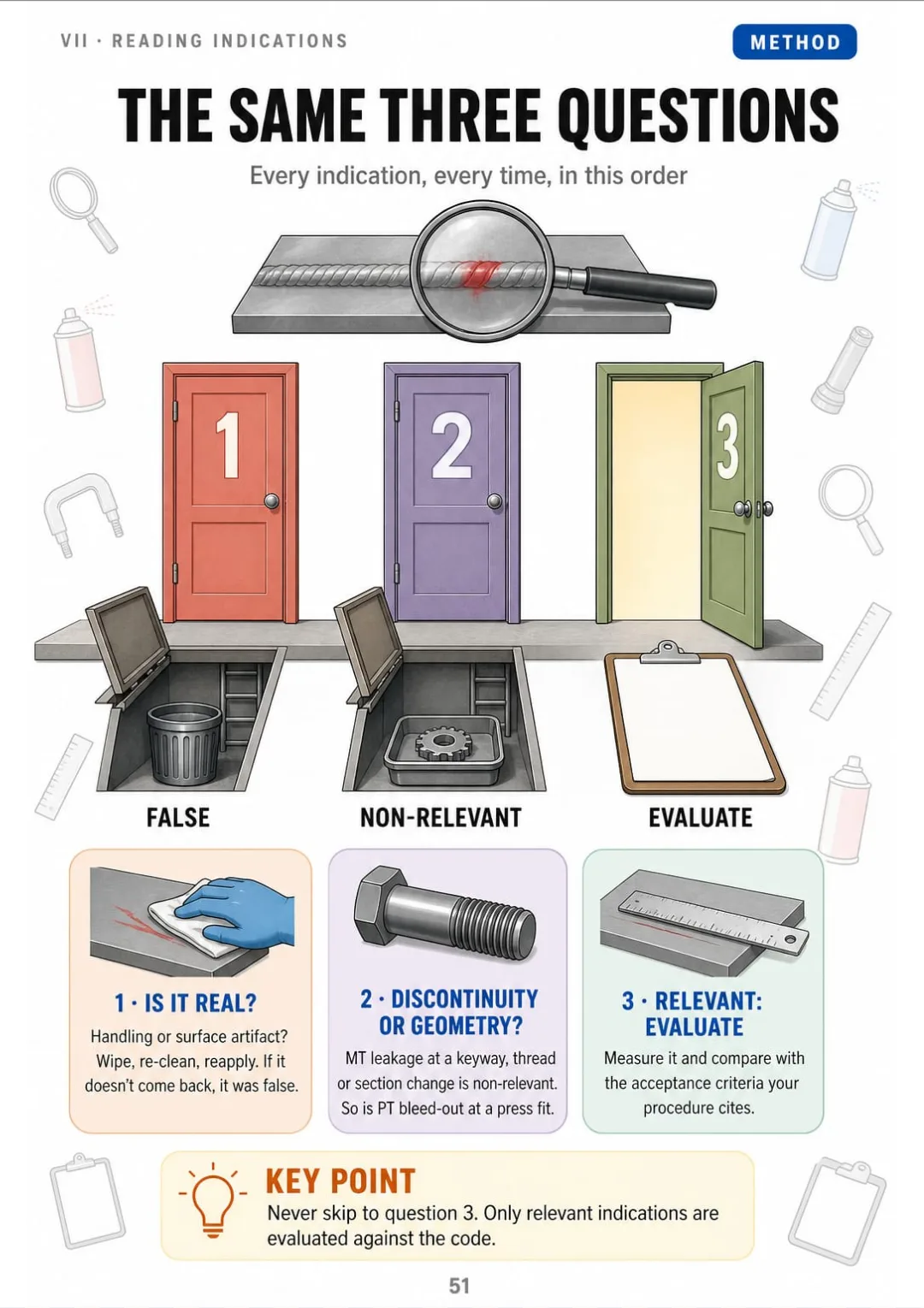
False → non-relevant → relevant: the three-door order for every indication
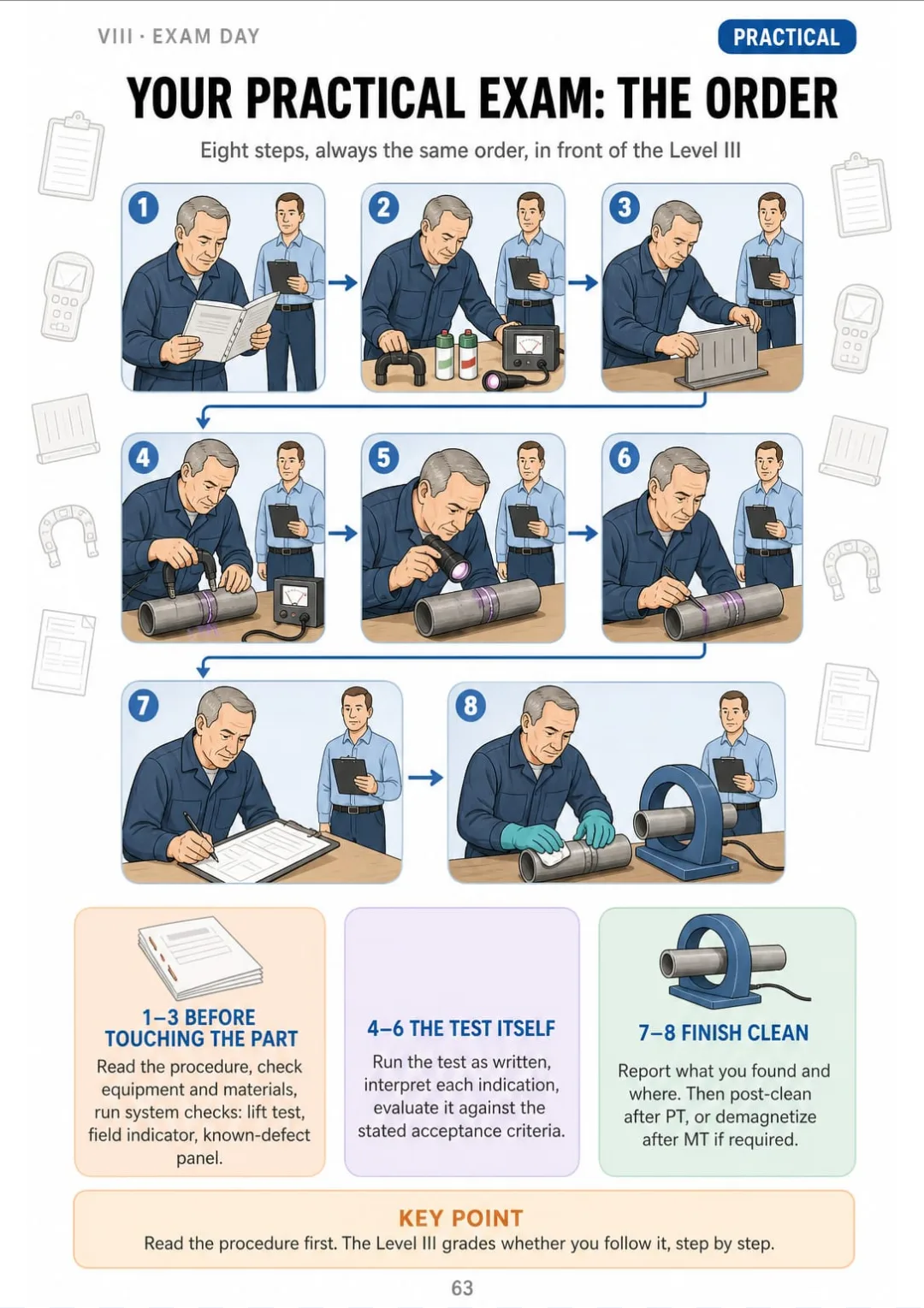
Procedure → equipment → system checks → test → interpret → evaluate → report → post-clean or demag

Swipe to see more →

These are real pages from the book. The table of contents is the full one: 8 parts and 60 topics.

The Problem Isn't You. It's How They Explained It.

You're at the bench with a 304 pipe spool and a 410 valve body, and the practice question asks: MT or PT for each? You know the metal. The question is worded to make you doubt.

The manual covers it in three paragraphs on permeability, austenitic and martensitic grades and magnetic domains. Every word is right, but nothing shows you the answer.

MT only on ferromagnetic metal: most 304/316 stainless, aluminum, copper and titanium go to PT.

In the book, it's one page: ferromagnetic metals on one side, everything else on the other. Most 304 and 316 stainless, aluminum, copper and titanium go to the PT column; carbon steel and 410 can take the yoke.

Same with the leakage field, field direction vs. crack orientation, the six PT steps, Type I vs. Type II and the three questions for every indication: each one has its own page.

You see the part and you know the method. You pick up the yoke or the penetrant kit without going back to the manual.

COMPARE FOR YOURSELF

The Same Topic, Two Ways to Study It

THIS
  • The manual: line after line
  • Discontinuities and defects explained only in words
  • You walk into the exam with doubts
A discontinuity is defined as an interruption in the normal physical structure or configuration of a part, such as cracks, laps, seams, inclusions or porosity, which may or may not affect the usefulness of the component. A defect, conversely, is a discontinuity or group of discontinuities whose size, shape, orientation, location or properties fail to meet the specified acceptance criteria and which is therefore rejectable. Consequently, all defects are discontinuities, but not all discontinuities constitute defects, a distinction established in ASTM E1316 terminology and applied per the referencing code.
FOR THIS
  • Discontinuity vs. defect in one drawing
  • The acceptance criteria in a box
  • You see which one gets rejected, and why
Defect = a discontinuity that fails the acceptance criteria (ASTM E1316 terminology).
CONTENTS

Take a Look at the 8 Parts and 60 Topics

The job and the exam, discontinuities, how MT works, MT on the job, the six PT steps, PT methods and controls, reading indications and exam-day review: 64 pages, all illustrated.

IBefore You Start: The Job and the Exam · pp. 5-10
  1. Where MT and PT Fit in NDT
  2. Level I, Level II, Level III: Who Does What
  3. Your Employer's Written Practice
  4. Training and Experience Hours at a Glance
  5. The Three Exams: General, Specific, Practical
  6. The Vision Test You Need Every Year
IIDiscontinuities: What You're Hunting · pp. 11-16
  1. Discontinuity vs. Defect
  2. Inherent, Processing and Service Discontinuities
  3. Weld Discontinuities That Reach the Surface
  4. Forging and Casting Discontinuities
  5. Fatigue Cracks: The Service Crack
  6. Tight, Shallow, Subsurface: What Each Method Can See
IIIMT: How Magnetism Finds Cracks · pp. 17-25
  1. Ferromagnetic or Not?
  2. The Leakage Field: Why Particles Gather
  3. Field Direction vs. Crack Orientation
  4. Circular Magnetization
  5. Longitudinal Magnetization
  6. AC vs. DC vs. Half-Wave
  7. Permeability, Retentivity, Coercive Force
  8. Continuous vs. Residual Method
  9. Curie Point and Temperature Limits
IVMT on the Job: Equipment and Technique · pp. 26-34
  1. The Yoke: Your Everyday Tool
  2. Yoke Lifting Power Check
  3. Prods: Circular Field Between Two Points
  4. Coils and Fill Factor
  5. Head Shot and Central Conductor
  6. Proving the Field: Pie Gauge, Shims, Gaussmeter
  7. Dry Particles
  8. Wet Particles and the Settling Test
  9. Demagnetization and Residual Field
VPT: The Six Steps · pp. 35-43
  1. The Six PT Steps on One Page
  2. Step 1: Pre-Cleaning
  3. Step 2: Applying the Penetrant
  4. Step 3: Dwell Time
  5. Step 4: Removing Excess, Solvent-Removable
  6. Step 4: Removing Excess, Water-Washable
  7. Step 4: Post-Emulsifiable, Lipophilic and Hydrophilic
  8. Step 5: Developing
  9. Step 6: Inspect and Post-Clean
VIPT: Methods, Materials and Controls · pp. 44-50
  1. Type I and Type II: Fluorescent vs. Visible
  2. Methods A, B, C, D in One Table
  3. Sensitivity Levels
  4. Developer Forms
  5. UV-A and White Light Requirements
  6. Material Compatibility: Sulfur, Halogens, Oxygen
  7. System Checks: TAM Panel and Known-Defect Standards
VIIReading Indications · pp. 51-57
  1. Relevant, Non-Relevant, False: The Same Three Questions
  2. False Indications
  3. Non-Relevant Indications in MT
  4. Linear vs. Rounded Indications
  5. What the Shape Tells You
  6. Evaluating Against Acceptance Criteria
  7. Writing the Report
VIIIExam Day and Review · pp. 58-64
  1. MT vs. PT Side by Side
  2. Numbers to Have at Hand
  3. The Most Frequent MT Technique Errors
  4. The Most Frequent PT Technique Errors
  5. How Questions Are Worded on General and Specific Exams
  6. Your Practical Exam: The Order to Follow
  7. Last-Night Checklist

One Page, One Topic, All Clear

Think of it this way:

Your practical exam is next week. The Level III will hand you a welded plate and a yoke, and you need to know where the second shot goes.

The night before, you open the book to the yoke page and see it drawn: the field running pole to pole, the second shot turned about 90°, the coverage overlapping.

PT in six panels: clean, penetrant, dwell, remove excess, dry and develop by developer type, inspect, then post-clean.

The prods, wet particles and the settling test, the six PT steps and the three questions for every indication work the same way: one topic, one page.

NDT Illustrated: MT & PT is 8 parts and 60 topics, all drawn, with an exam-day review at the end: MT vs. PT side by side, the numbers to have at hand and the most frequent technique errors.

What you see drawn, you don't have to memorize.

What's Inside NDT Illustrated: MT & PT:

Ipp. 5-10

Before You Start: The Job and the Exam

Know exactly where you stand before you study: where MT and PT fit, Level I, II and III, your employer's written practice, training hours, the three exams and the yearly vision test.

IIpp. 11-16

Discontinuities: What You're Hunting

Discontinuity vs. defect, inherent, processing and service discontinuities, weld, forging and casting flaws, fatigue cracks and what each method can see.

IIIpp. 17-25

MT: How Magnetism Finds Cracks

Ferromagnetic or not, the leakage field, field direction vs. crack orientation, circular and longitudinal magnetization, AC vs. DC vs. half-wave, permeability and retentivity, continuous vs. residual, Curie point.

IVpp. 26-34

MT on the Job: Equipment and Technique

The yoke and its lifting power check, prods, coils and fill factor, head shot and central conductor, pie gauge and shims, dry and wet particles, demagnetization.

Vpp. 35-43

PT: The Six Steps

All six steps on one page, then each one: pre-cleaning, penetrant, dwell time, removing excess (water, emulsifier or solvent), developing, inspection and post-cleaning.

VIpp. 44-50

PT: Methods, Materials and Controls

Type I vs. Type II, Methods A to D in one table, sensitivity levels, developer forms, UV-A and white light, material compatibility and system checks.

VIIpp. 51-57

Reading Indications

The same three questions, false and non-relevant indications, linear vs. rounded, what the shape tells you, acceptance criteria and the report.

VIIIpp. 58-64

Exam Day and Review

MT vs. PT side by side, numbers to have at hand, the most frequent MT and PT errors, how exam questions are worded, the practical exam and a last-night checklist.

At the end of the book: An exam-day review part: MT vs. PT side by side, numbers to have at hand, the most frequent errors and a last-night checklist.
Plus: 2 Free Books

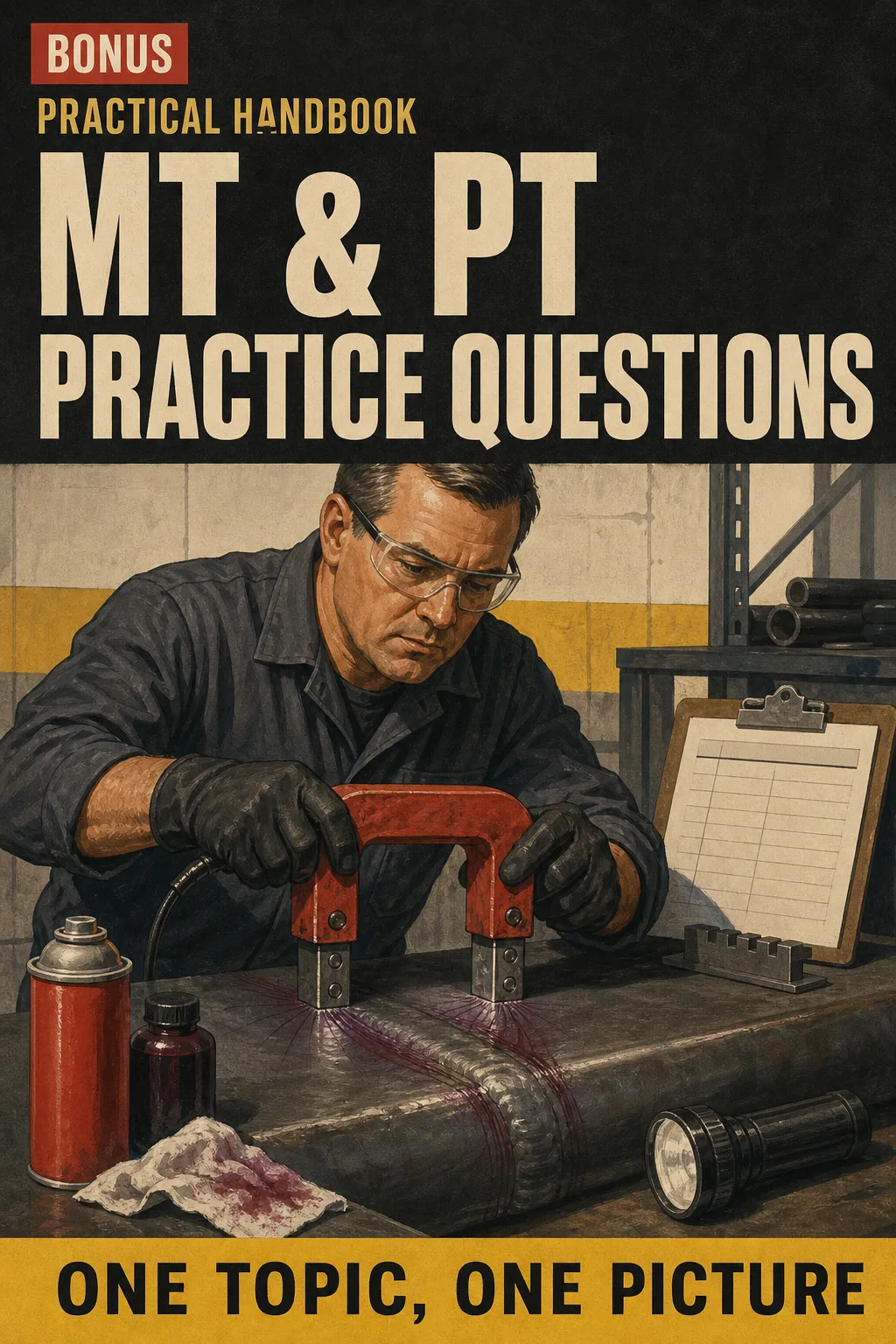
MT & PT Practice Questions

BONUS 1: «MT & PT Practice Questions»

Value on its own: US$ 17.90

Exam-style questions on both methods with the answer explained, so you find your weak spots before the real test, not during it.

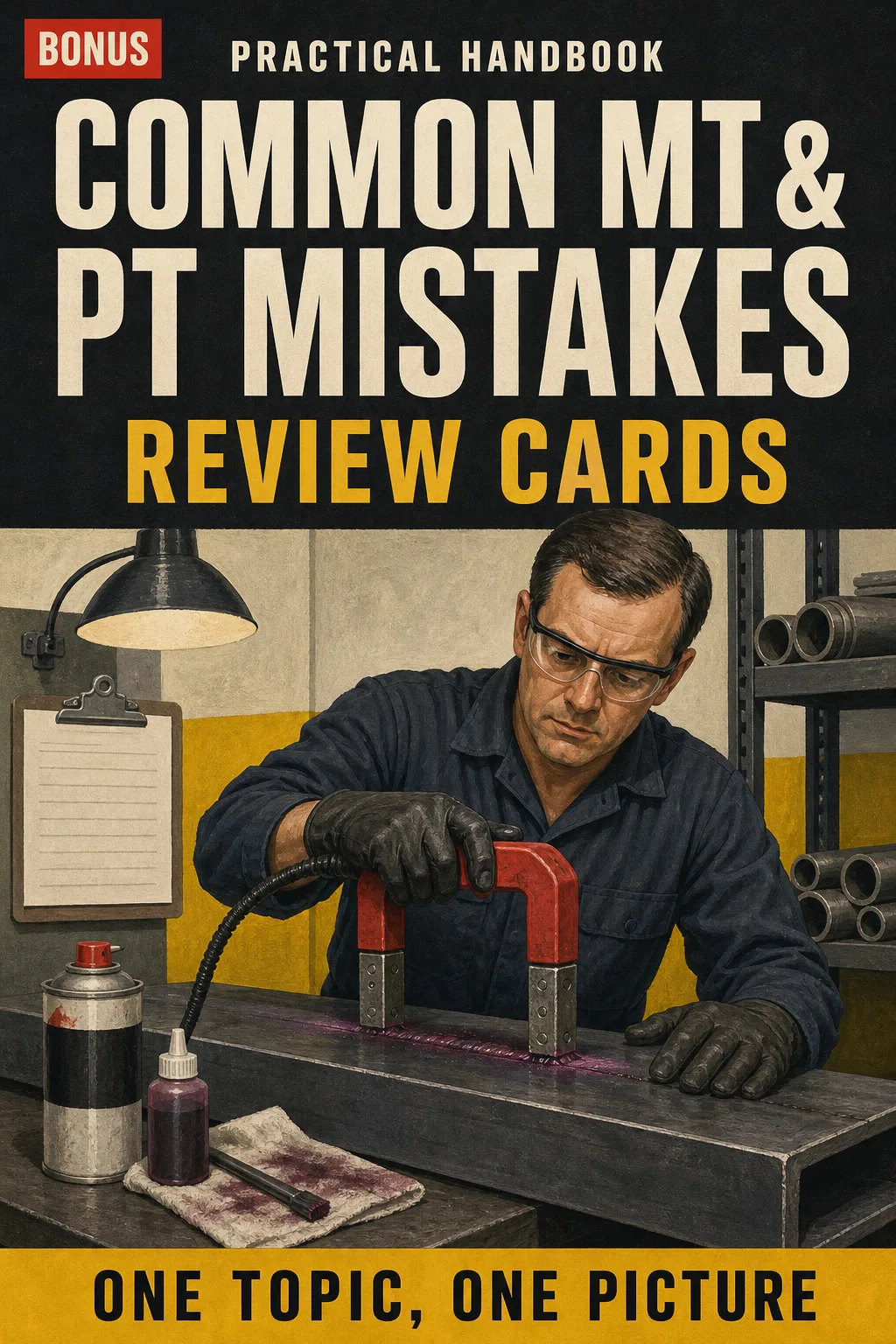
Common MT & PT Mistakes: Review Cards

BONUS 2: «Common MT & PT Mistakes: Review Cards»

Value on its own: US$ 14.90

The most frequent technique errors on one card each (over-removal, short dwell, wrong field direction, skipped demag), drawn side by side with the right way, to review the night before.

NDT Illustrated: MT & PT with 2 Free Books

  • NDT Illustrated: MT & PT: 64 illustrated pagesUS$ 63
  • BONUS 1: MT & PT Practice QuestionsUS$ 17.90
  • BONUS 2: Common MT & PT Mistakes: Review CardsUS$ 14.90
  • High-resolution PDF to printIncluded
Total value US$ 95.80
YOUR PRICE:
US$ 27
You save US$ 68.80
YES, I WANT NDT ILLUSTRATED: MT & PT FOR US$ 27

📄 This is a digital PDF book sent to your email: nothing is printed or shipped.

Secure purchaseEncrypted payment30-day guarantee

PDF by email: We email you NDT Illustrated: MT & PT as a PDF, together with the two free books. It's a single payment: no installments, no extra charges.

Who This Book Is For

You're in your company's NDT training

You're in your company's NDT training

Every topic from class gets its own page to come back to, so the course theory stays in order.

Your Level I or II exam is coming up

Your Level I or II exam is coming up

You review MT and PT in the same order every time, with the practice questions to find your weak spots before the real test.

You already inspect with a yoke or a PT kit

You already inspect with a yoke or a PT kit

Print the pages you need and keep them at hand on the job, in front of the supervisor or the auditor.

Everything You Get Today

US$ 95.80US$ 27
YES, I WANT NDT ILLUSTRATED: MT & PT FOR US$ 27

📄 This is a digital PDF book sent to your email: nothing is printed or shipped.

30DAYS
GUARANTEE

30-Day Guarantee

Try NDT Illustrated: MT & PT for 30 days, bonus books included.

We refund everything if the file won't open, if the book isn't what you see here, if you were charged twice or if the email doesn't arrive. Just email us.

You pay once. No subscriptions.

Frequently Asked Questions

Is it for me if I've worked around welds for years and now need my MT/PT certification?

Yes. It's built for people who already know welds and defects and need the MT and PT theory in order. It isn't a new course: it's the same theory as your manual, one topic per page, drawn, so you can review it in the same order every time. Your question books test you; this one shows you why the answer is what it is.

Where does the content come from?

From ASNT SNT-TC-1A, ASME Section V Articles 6 and 7, and ASTM E1444, E709, E1417 and E165. The MT and PT theory is the same whether your employer follows SNT-TC-1A, ANSI/ASNT CP-189 or NAS 410. What changes are the hours, the exam rules and the acceptance criteria, and those come from your written practice. Every code value is flagged to check against your written practice and the edition it cites.

Is it official material?

No. It's independent study material, not issued or endorsed by ASNT, ASME, ASTM, AWS or any certifying body. It doesn't give you a certificate either: under SNT-TC-1A, your employer certifies you through its written practice, your training hours, your experience and your exams. This book helps you study for those exams.

Does it replace my training course?

No. It doesn't replace your training hours, your experience hours or your employer's written practice. It helps you review what you learn there.

Are the practice questions the ones on the exam?

No. They're written for this book, in exam style, with the answer explained. They aren't official questions from any exam.

When and how do I get it?

The book and the 2 bonus books arrive as PDFs by email, at the address you enter at checkout.

Do I have to pay every month?

No. It's a one-time payment.

Can I have it on paper?

Yes. The PDF is ready to print: the whole book, or just the pages you want to keep at the shop.

How does the refund work?

You have 30 days. We refund everything if the file won't open, if the book isn't what you see on this page, if you were charged twice or if the email doesn't arrive: just email us.

Before You Close This Page

No more rereading without anything sticking.

Field direction and crack orientation: you see them drawn, and that's it.

You walk into the exam knowing where everything is.

Drawings make studying faster.

The book is right below.

One-time payment: US$ 27 · Guarantee: 30 days · PDF by email

YES, I WANT NDT ILLUSTRATED: MT & PT FOR US$ 27

📄 This is a digital PDF book sent to your email: nothing is printed or shipped.